Teen Summit 2.0: The Remix · Research statement

Research

A pilot, and what comes next. Practicing civic life through Facts, Funk, Feelings and Fixes—and asking what we can learn from that practice.

Illustration of a glowing brain held in two hands
Conceptual illustration of the program’s learning framework—not a brain scan or evidence of measured neural effects.

01 / A pilot, and what comes next

Civic life, practiced in public.

Teen Summit 2.0: The Remix is a pilot. It tested whether a research-based civic curriculum could be taught to teenagers inside a working television production and still hold up as television. The pilot season was built, filmed and wrapped in 2026 with 22 Summiteers at the University of Illinois Urbana-Champaign. The project is now seeking funding for Season One.

The project is housed in the Communiversity Public Media Project (CPMP) in the College of Education, under the University’s Publicly Engaged Research Option (PERO) pathway. Its premise is simple: young people learn civic life by practicing it in public, with facts, music and feeling in the same room.

The pilot generated broadcast footage, a digital archive, a curriculum and a first research paper. The broadcast pilot is still in post-production; this is not an announcement of a completed or aired episode. Season One is intended to turn that pilot into a study.

02 / The research intervention

The show’s design is the research.

Dr. Malaika McKee built Teen Summit 2.0 around a four-act architecture, the Quad-4. The acts are the intervention that the teens experience and that the proposed research will observe. According to the program’s statement, the March 2026 production agreement with Illinois Public Media named this architecture as the primary research intervention and as Dr. McKee’s proprietary scholarly and creative work.

The four-act architecture
ActNameWhat the Summiteers doCore heuristic
IFactsDialogue, not debate, on a contested public questionFlip the Script, Back it Up!
IIFunkMusicology: reading the civic argument inside a songMusicology segment format
IIIFeelingsConfessionals and group reflection on what the dialogue cost and gaveDouble Click
IVFixesDecisions and civic action beyond the studioAcademic Civic NIL

The first three acts were filmed for broadcast. The fourth, Fixes, was added after a May 9, 2026 mock city council at Champaign City Hall showed that the teens needed a place to decide and act, not only to talk. Fixes lives on the digital side of the project, here at teensummit2.net.

The Quad-4 is documented as a metacognitive schema. Its proposed mapping onto attention and social-cognition systems is a working correspondence that guides curriculum design—not a claim about where civic reasoning sits in the brain, or evidence of specific neural changes. Whether that correspondence has value beyond a design heuristic remains a question for research.

03 / What the pilot produced

From the studio to a shared record.

The pilot ran from a public launch on February 3, 2026 to a Wrap Ceremony on June 22, 2026, with studio production from March 26 through early May. The program’s statement identifies these outputs:

  • A paid pilot cohort. 22 Summiteers were cast through an open application process and employed as University Extra Help workers at $20 per hour, so that civic labor was paid labor. This describes the historical pilot cohort, not current recruitment.
  • Broadcast footage, now in post-production. A full season of footage across Facts, Funk and Feelings is being shaped into a three-act broadcast pilot, with a direction to the website for Fixes.
  • A curriculum. Summiteers learned dialogue heuristics, musicology and reflective practice through a Canvas course. The preserved course described on Backstage Prep is a post-pilot refinement, not an identical snapshot of the course used throughout filming.
  • Measurement and design work. Work on the Quad-4 schema includes a topic audit of dialogue sessions and the design history that led to the fourth act.
  • A first research paper. The statement reports a peer-reviewed paper presented at the 2026 American Educational Research Association (AERA) annual meeting.
  • A digital archive. B-roll, teen confessionals and the CORN companion podcast—Conversations on Real Narratives—form short-form digital content at teensummit2.net.

The program’s statement describes the pilot as a CPMP public engagement project, conducted without an IRB protocol, and states that a protocol was not needed to produce a television program or describe a civic engagement model. This is the program’s account, not an independent regulatory determination or a claim of a vetted exemption. Season One is planned as human subjects research from the start, with IRB approval to be sought.

04 / How the pilot was built

The portfolio behind the pilot.

The November 2 statement describes an $845,000 portfolio assembled between 2024 and 2025. This is a portfolio of appropriations, allocations and reported philanthropic support—not a total of cash confirmed received or spent. Roughly $432,500 in in-kind partnership support is reported separately and is not cash funding.

Source-described portfolio: $845,000, with receipt status distinguished
SourceAmountPurposeQualification
State of Illinois program appropriation (FY26)$330,000Teen Summit 2.0: Communiversity Public Media Project programmingProgram appropriation; not represented here as funds received.
Illinois DCEO capital allocation (Build Illinois)$350,000Renovation of space for a statewide media projectCapital appropriation remains in the administrative process; not confirmed received.
Founding gift, Ms. Sheila Johnson$140,000Launch of the new Teen SummitReported founding gift; this statement does not independently establish receipt or spending.
University of Illinois Foundation / Advancement$25,000Project supportReported Foundation / Advancement support; not a receipt or expenditure accounting.

The state appropriation was carried by Representative Carol Ammons. Ms. Johnson, creator of the original Teen Summit on BET, set one condition for the revival: the new show would be for all kids.

Production ran in partnership with Illinois Public Media under a March 12, 2026 memorandum of understanding between the College of Education and the College of Media. The Safe Haven, with Walt Bowman as digital producer, built the digital side, and Dr. Molly Niesen served as impact producer.

Dr. McKee led the project as the 2025–26 Chancellor’s Fellow for Public Engagement, an appointment that charged her with the strategic planning, development and implementation of Teen Summit 2.0.

05 / Season One: from pilot to study

What does the practice change?

The pilot demonstrated a production possibility: the Quad-4 could be taught, filmed and held together in a studio with real teenagers and real disagreement. That is not evidence of learning or neurological effects. Season One is intended to study what the experience does for participants.

Three questions lead the proposed research design.

  1. Dialogue, not debate. Do the Facts heuristics—Flip the Script, Back it Up!—change how teens handle a claim they disagree with, measured before, during and after the season?
  2. The Quad-4 as a schema. Does moving a civic question through Facts, Funk, Feelings and Fixes produce reasoning that a single-mode civics curriculum does not?
  3. Civic action after the cameras stop. Do the proposed Fixes commitments, carried through Academic Civic NIL and the Mayoral Recognition Program, persist past the season?

What Season One funding would support.

  • Development of a research protocol for planned IRB review and approval, including pre- and post-season instruments and a comparison cohort.
  • A full production season with a paid Summiteer cohort, using the pilot’s $20-per-hour standard.
  • A dedicated post-production budget and editor, contracted at the start of the season rather than the end.
  • Digital-side research outputs: the Quad-4 design-history paper, the topic audit and open curriculum materials.
  • A community viewing and teach-in series under the Welcome Table for Democracy, so findings return to the public that produced them.

Spring 2027 is the target for Season One production, not a secured schedule. Funding, research approval, partners and venues are not announced here as secured. Partners, venues and the funding level will be announced as commitments are secured.

06 / Seeking a neuroscience research partnership

A hypothesis. An invitation to test it.

Dr. McKee’s hypothesis asks whether civic mindedness has observable neuroscientific dimensions. The pilot raised that question but could not answer it. No neurological outcome is established by the pilot.

The Quad-4 was built on a working correspondence between its four acts and systems involved in attention, perspective taking, conflict monitoring and decision-making. Facts asks a teen to hold a claim and its opposite at once. Funk asks them to hear an argument inside music. Feelings asks them to sit with what the dialogue cost. Fixes asks them to decide.

Those connections are a design heuristic, not a localization claim that each act activates one brain region. Brain regions and networks participate in many functions. The proposed research would ask whether the mapping is useful beyond curriculum design.

The project welcomes prospective collaborators in cognitive and social neuroscience, developmental neuroscience and the neuroscience of attention who want to work with a live civic intervention, a planned paid teen cohort and recorded dialogue. A partnership would help design behavioral and attentional measures, with neuroimaging considered only where feasible and appropriate for minors, and would be incorporated into the planned Season One IRB protocol from the start.

Conversations with researchers at the University of Illinois—including the Beckman Institute and the Neuroscience Program—and at other institutions are welcome. This is an invitation to develop research, not an announcement of secured research partners, an approved protocol or an open participant-recruitment process.

07 / Leadership & contact

Everyone belongs at the table.

Dr. Malaika McKee is Creator, Showrunner, Principal Investigator and Executive Producer of Teen Summit 2.0: The Remix, and composer of its theme song. She is Director of the Communiversity Public Media Project; Assistant Professor in Education Policy, Organization and Leadership in the College of Education at the University of Illinois Urbana-Champaign; and the 2025–26 Chancellor’s Fellow for Public Engagement.

The intellectual lineage of the project runs through Dr. Vincent Harding, Rosemarie Harding, Rachel Harding and the Welcome Table: the idea that everyone belongs at the table of humanity to fix the planet’s problems, teenagers most of all.

Funders, prospective research partners and community partners interested in Season One can reach the project at 217-244-5257 or staff@teensummit2.net, or through teensummit2.net.

Civitas.
Research Dossiers

Teen Summit 2.0: The RemixWeb platform and digital production by The Safe Haven Studio.

Comprehensive research materials and debate topics for Teen Summit participants. Download and study these resources to prepare for your debates.

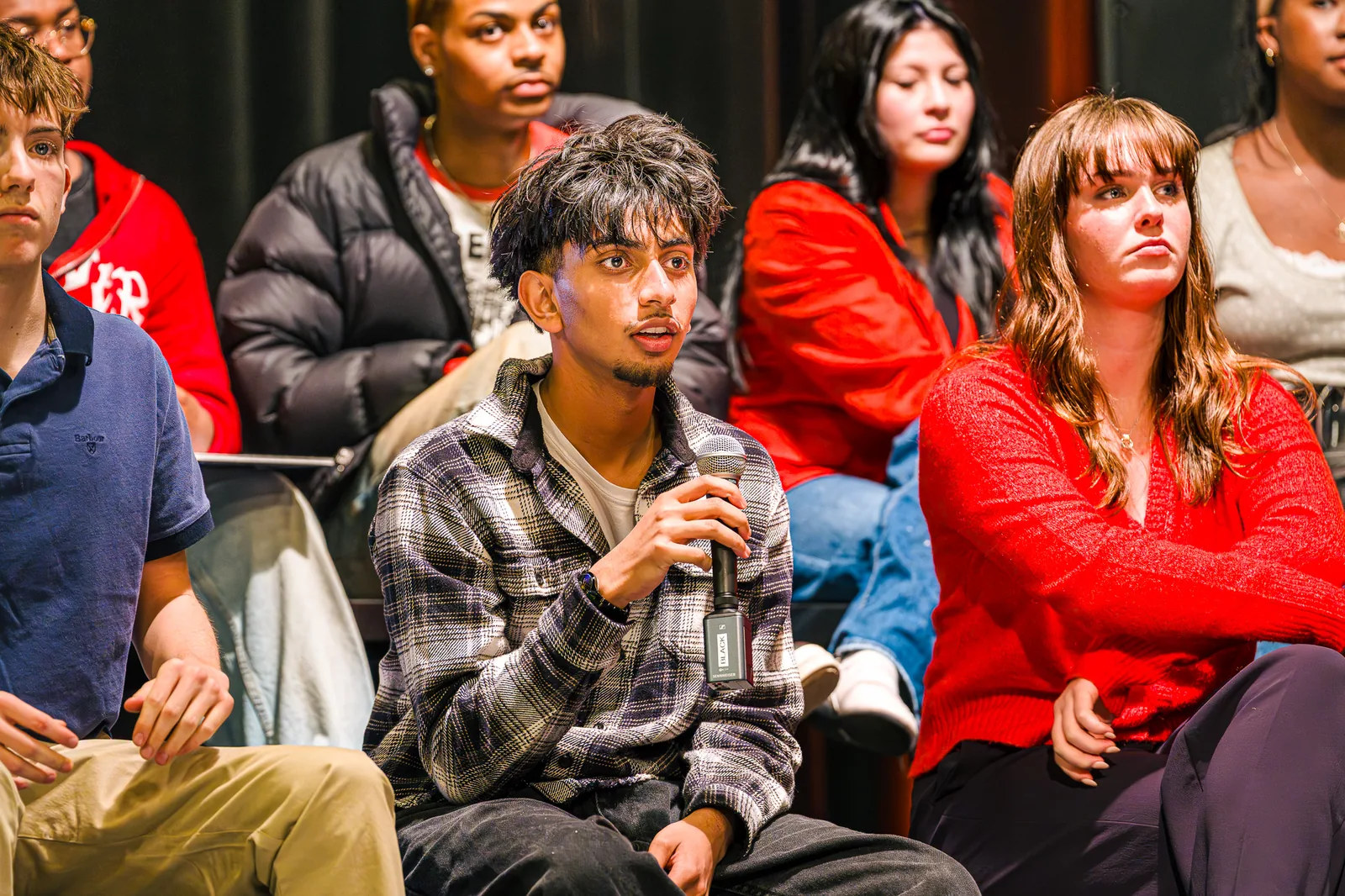
Summiteers engaged in dialogue during production

Public curriculum preview

Prepare both sides. Bring your own perspective.

Before the camera rolls, Summiteers read evidence for two positions, write up both arguments, connect the topic to their community and music, and reflect on their own experience.

The pilot’s three topics

  • Teens and Social Media: how responsibility for online harms is shared among technology companies, parents and individuals.
  • Teens and College Paths: community perspectives on college and what it means in a young person’s life.
  • Teens and Education Authority: how young people encounter questions of curriculum authority and community voice.

This summary comes from the approved Backstage Prep narrative. It is not access to a private Canvas course, student work or protected readings. Public dossier downloads appear below only when available.

Live dossier downloads could not be loaded. The public curriculum preview remains available.

Downloads are temporarily unavailable.

Check back soon for research materials!

Teen Summit 2.0: The Remix · The curriculum behind the show

Backstage Prep

Backstage Prep for Civic Performance: the preparation behind the Summiteers’ unscripted dialogue.

# BPFor civic performance
Around the studio table · 9-second silent excerpt. Participants sit together beneath the production lights.
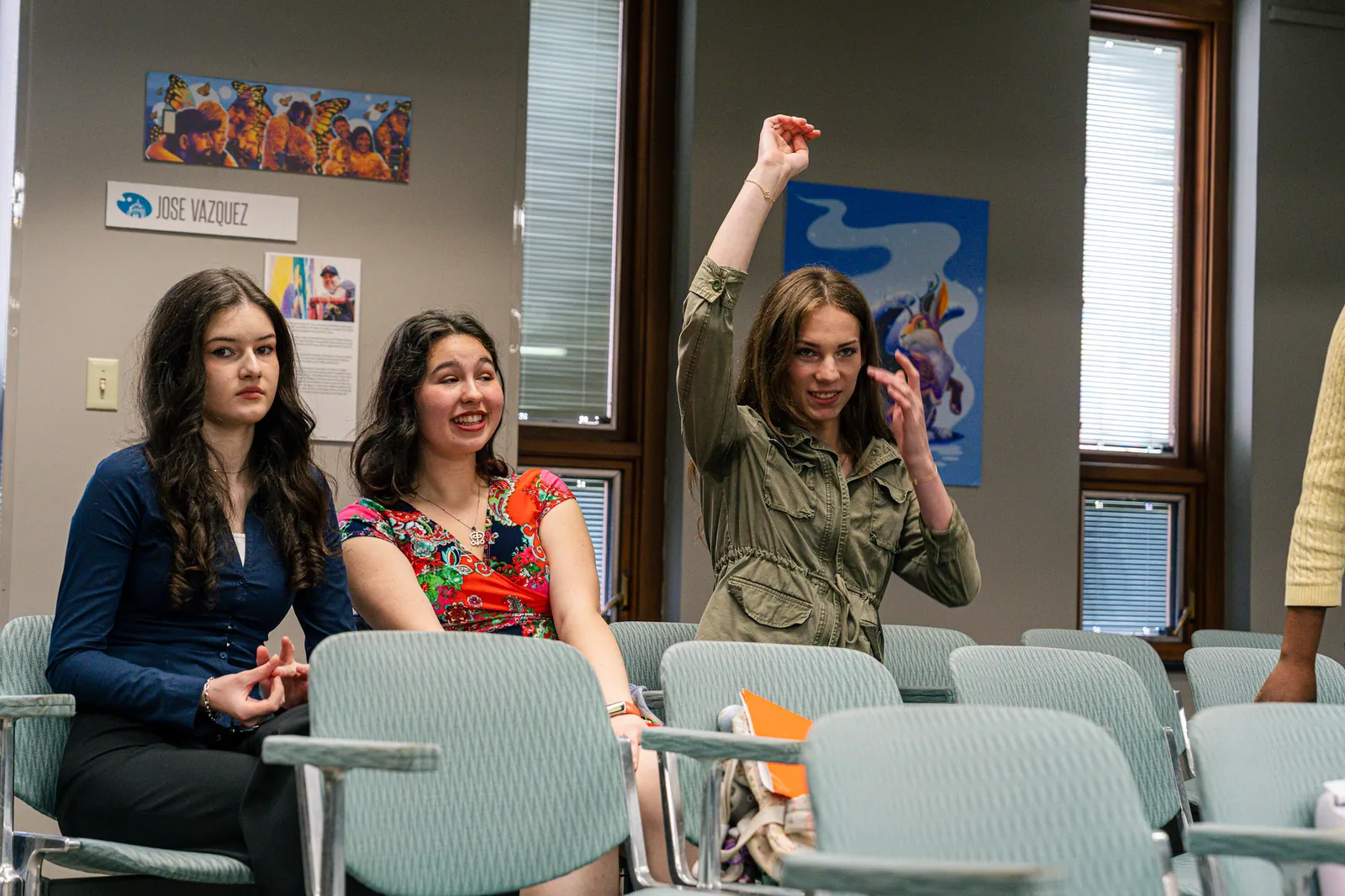
A participant raises a hand while others sit nearby in a meeting room.
Taking part in the conversation. From the Teen Summit photo collection.

What Backstage Prep is

Backstage Prep for Civic Performance is the pre-production curriculum that prepared the Summiteers of Teen Summit 2.0: The Remix to be camera-ready. It has three parts that worked together. The first is the Summiteer Onboarding Book, a printed orientation booklet given to the inaugural class of 2026 that set out the legacy of the original Teen Summit, the production team, the three-act structure, the production schedule, the wardrobe guide, the Source / Sample / Sale framework, the Academic Civic NIL, standards of conduct, digital consent, and the full season calendar. The second is the Summiteer's Guide, an onboarding deck delivered in person that taught the cast how each act runs on the floor: who sits where, what can be called, and in what order the questions come. The third is the Canvas course, a homework sequence by polemical topic that every Summiteer completed before stepping onto the set. The book told them who they were and what the season would ask; the guide told them what the floor would ask; the course made sure they arrived able to answer.

The curriculum was written by Dr. Malaika McKee in collaboration with Dr. Molly Niesen, Impact Producer, and with doctoral students Soomin Nam, Jeongsan Hwang, and Hanna Kim of the University of Illinois College of Education, who were studying Higher Education, Philosophy of Education, and Education Policy, Organization and Leadership. DJ Silkee (Ja'Nae Modest), hip hop pedagogist and faculty at the Dr. William Patterson Hip Hop Innovation Center, who leads the Musicology act of the show, developed the Musicology portion. The Canvas course was hosted with the support of the University of Illinois Center for Innovation in Teaching and Learning (CITL). Its home page presents the model as six doors: Flip the Script, Musicology, Double Click, a Virtual Meeting Room, the Teen Summit hub, and the Discussion Board.

All three parts translate the show's Quad-4 framework, Facts, Funk, Feelings, and Fixes, into preparation. The Summiteer's Guide delivered in April 2026 named the fourth act Feedback (the VOX synthesis and the Collective Move). The act was renamed Fixes after the May 9, 2026 mock city council at Champaign City Hall showed that the show needed a decisional act, not only a reflective one.

How the topics were chosen

The curriculum is organized by polemical topic rather than by skill, and the topics were chosen through a three-stage process. The production team first built a master list of fifteen candidate topics from research on the issues teenagers themselves rank as most important, anchored in Pew Research Center surveys of teens and supplemented by adolescent health data, Gen Z values research, school policy studies, and tracking of live legislation affecting youth. Each candidate was screened for four qualities: it had to be alive in the cultural moment, encountered in teens' daily experience, open enough that a thoughtful teen could hold either side, and generative of larger conversations about identity and democratic life.

The team then audited the list against the show's Default Mode Network hypothesis, keeping only questions in which a teenager is the subject rather than a spectator, and setting aside topics with a morally obvious answer or a policy-knowledge barrier. Finally, the Summiteers voted on the surviving slate by topic interest. Three topics won the vote and became the pilot curriculum: Teens and Social Media, Teens and College Paths, and Teens and Education Authority.

Adults curated for evidence and cognitive fit; teens chose for relevance. That division of labor is what keeps the curriculum both rigorous and theirs.

The Canvas arc: one topic, fourteen pages

Each topic on Canvas follows the same fourteen-page arc, so that by the third topic the Summiteers know the rhythm of civic preparation by heart.

Every topic opens with a story. Topic 1 begins with "Aliyah's Story," a short narrative about a teenager's ordinary morning scroll, followed by a current news hook ("Who's Responsible? Big Tech on Trial," built around the 2026 social media addiction litigation against Meta and Google) and a single framing question: who should bear the most responsibility for harms linked to social media use, tech companies, parents, or individuals? The story makes the issue personal; the news hook makes it public; the question makes it arguable.

From there the topic moves to the Idea Map, a visual grid that lays out Position A and Position B as sets of claims. For Topic 1, Position A (greater corporate responsibility) holds that tech companies design for maximum engagement, profit from user data and attention, have the capacity to reduce harmful content, and may need regulation to protect young users. Position B (greater parental and individual responsibility) holds that overregulation risks limiting free expression, that social media can be beneficial and individuals can shape their own experience, that parents control access and digital boundaries, and that personal responsibility is essential in a free society.

The Sources and Evidence section then gives each position its own readings, drawn from primary and reputable sources (for example, HHS guidance, COPPA, and Pew Research Center survey data on teens and screen time). Summiteers read both sides and complete a Position A Write-Up and a Position B Write-Up. No Summiteer is allowed to prepare only the side they agree with, because on the set they may be asked to carry either position with evidence.

A Comprehensive Quiz (Topic 1) or shorter Check-ins (Topics 2 and 3) confirm that the facts have landed before the feelings are invited in. The Reflection and Discussion section then runs three discussion posts per topic, and this is where the other acts of the show enter the homework. The first post ("Your Community and Social Media," "Your Community and College Paths," "Your Community and Curriculum Authority") asks Summiteers to locate the issue in their own neighborhoods and schools. The second post, "Songs that Speak to You," is the Musicology act, developed with DJ Silkee: each topic has a curated Summiteers' Playlist (twenty-two tracks for Topic 1, ranging from Gorillaz's "The Tired Influencer" to Olivia Rodrigo's "jealousy, jealousy" and Steve Lacy's "Bad Habit"), and the Summiteers write about which songs name the issue for them. The third post ("Critical Reflection," "What Does College Mean to YOU?," "Influencers and Social Media") is the Double Click, where the Summiteers turn the analytic lens on their own feeds and their own feelings. Topics 2 and 3 close with a "Your Story" assignment in which each Summiteer writes the personal narrative they will bring to the Confessional and to their Academic Civic NIL.

The result is a model with a fixed architecture and swappable content. Story, question, idea map, dual-position evidence, dual write-ups, assessment, community reflection, musicology, double click, and personal story: the sequence is the same for every topic, which is what makes the curriculum portable to a new set of polemical topics, a new cohort, or a new city.

Orientation: the ESPN curriculum

Before any homework was assigned, the Summiteers were oriented over two sessions at the end of March 2026, and the second session used ESPN's own training as the curriculum. The cast watched ESPN's videos on how the network prepares its on-air talent and runs its talk shows, and studied them to learn how to talk under pressure: how anchors hold a position on live television, take a challenge without losing the thread, and keep a conversation moving when the camera does not stop. Jaime Roundtree, the hip hop pedagogist, had observed that an ESPN roundtable looks effortless because of preparation the audience never sees: research packets, a rundown set the night before, a producer in the anchor's ear. SportsCenter is a Socratic seminar with a highlight reel, and the Summiteers were learning to do what the desk does.

The parallel was laid out side by side. Anchors arrive with research packets; Summiteers come with their own research and lived experience. A producer sets the rundown; Dr. McKee sets the Quad-4 structure. Everyone on the desk knows the topic and nobody reads from a script; everyone in the cast knows the framework and nobody reads from a script. On the desk the best take wins the room, not the loudest voice; at the roundtable the most honest voice moves the room. On the desk disagreement is the format, not the breakdown; at the roundtable disagreement is civic practice, not conflict. The audience feels the desk's preparation as presence, and feels the Summiteers' confidence as preparation.

The session ran in the Collins Studio with breakout groups, and the Summiteers were deliberately shuffled across groups so that trust formed across the cohort rather than inside friend clusters. It also introduced the four-part heuristic in its first form (Facts, Funk, Feelings, and a fourth F for the joy that makes civic work worth returning to) and taught the Summiteers that all four are always operating: in the show, in the room, and in themselves. The ESPN frame is why the Canvas homework and the Wednesday dossier drops never read to the cast as school. They were the research packet and the rundown. The Thursday roundtable was the desk.

The weekly rhythm and the Academic Civic NIL

The Canvas homework was not left to chance. The Onboarding Book set a four-day weekly rhythm for the production cycle, and the job description made the homework part of the paid work. Tuesdays were two hours of independent Canvas study, monitored by the production team, with a study log due by 11:59 PM; the Tuesday focus moved from the onboarding modules to each episode's dossier and argument development. Wednesdays were two-hour dossier drops and rehearsals, mostly in person at Campbell Hall, where the cast met with the hosts, Dr. Molly Niesen, the peer mentor discussant, and the creative team from The Safe Haven to talk through the curriculum guide for the coming topic. Thursdays were production days at Illinois Public Media. Saturdays were optional Academic Civic NIL sessions. Four study hours a week were built into the schedule, and the job description listed "completion of all required coursework, quizzes, and assignments on the Canvas learning management site" among the duties the $20-an-hour wage covered. The Summiteers were paid to prepare, which is why they prepared.

The Academic Civic NIL curriculum ran as six Saturday sessions in spring 2026, each with a forty-five minute instruction block led by Dr. McKee and Dr. Niesen, a creation lab led by Walt Bowman of The Safe Haven, and a fifteen-minute debrief in which every Summiteer committed to one thing they would post or act on before the next Saturday. Its premise is that athletes get brand training, media kits, and a packaged identity that travels with them, and that young civic leaders deserve the same, anchored in the issues they care about rather than in sport. The framework has three pillars: civic identity (know what you stand for), media fluency (know how to say it), and content presence (know how to be heard). Summiteers chose a content track, Story, Aesthetics, or Interview, and the six sessions moved from a civic platform statement and talking-head video (Who Are You?) through a published Fact Drop, a recorded mock interview, a live NIL profile and headshot, and an on-camera civic statement, to a complete media kit and cast photo. Each session's deliverable fed the Canvas dossier or a production day, so the Saturday work and the Thursday work were one curriculum seen from two sides.

From homework to floor: what the Summiteer's Guide taught

The Summiteer's Guide explained why the homework took the shape it did, by showing the cast exactly what each act would ask of them on the set.

Facts (Flip the Script). Five Summiteers sit at the table, chosen by live random draw on camera; the other nineteen sit on the risers as participants, not audience. Three calls govern the roundtable. Flip the Script: any participant can call it, and the speaker must immediately argue the opposite position and mean it. Receipts: someone challenges a claim, and the speaker either produces evidence or acknowledges they do not have it; no bluffing. Tag Out: a speaker who needs backup or a break signals the host, a riser Summiteer walks in, and the speaker returns to the risers. The random draw is why every Summiteer had to complete every topic, and Flip the Script is why the Canvas course requires both a Position A and a Position B write-up. The homework exists to make the flip survivable.

Funk (Musicology). Every track runs through six heuristic questions: the Source question (where did this sound come from?), the Body question (what does this music do to you physically?), the Story question (who made this, and why did it need to exist?), the Mirror question (how do you hear yourself in this?), the Argument question (what is this song trying to convince you of?), and the Inheritance question (what did this music give to what came after it?). The Summiteers answer the Body and Mirror questions first, before the hosts and the hip hop pedagogist, Jaime Roundtree, speak. A track cycle runs twelve to fifteen minutes, opening with ninety seconds of the full track and no talking, and closing with DJ Silkee dropping a current track live when a Summiteer names an artist, so that Source and Sample become visible in real time. The "Songs that Speak to You" posts and the curated playlists are the preparation for this act.

Feelings (The Double Click). Eight Summiteers at a time, fourteen to eighteen minutes, in an intimate studio. The act has three movements. The Feed: before shoot day each Summiteer chooses five social media accounts, one from each of five categories (fine art and visual culture, legacy media and documentary, influencer and creator, music and performance, news and current events), and brings them as their own data. The Click: one piece of content goes under the microscope through the Source / Sample / Sale framework (where did this idea come from, who borrowed it and how, who profits and from what) and the Liner Notes Test (does this content tell you where it got its ideas?). The Double: emotion to civic stance to leadership archetype to the Collective Move. The Canvas "Critical Reflection" and "Influencers and Social Media" posts prepare this act.

The guide closed with the standard for a great Summiteer on shoot day: come with the five accounts chosen deliberately, have a position and be willing to argue the opposite, speak from your own experience, let the silence breathe, name your emotion precisely, and listen to the riser teens, because they may shift the whole conversation.

Why this order

The Summiteers were told why the acts come in the order they do, not only what to do in each. The guide presented the show's structure as a civic arc that moves from personal identity to critical analysis to behavioral commitment, and mapped each act to a region of the adolescent brain as a heuristic: Facts to the Default Mode Network (personal history; who am I in this argument?), Funk to the temporoparietal junction (modeling origins; whose perspective am I taking?), and Feelings to the anterior cingulate cortex (action orientation; what will I actually do?). Fixes, named after the May 9 mock city council, completes the arc by recruiting the prefrontal cortex: deliberation becomes a proposal a governing body could vote on.

The guide also told the Summiteers that their own social media is the curriculum. Every account they follow is making an argument; their emotional reaction to a post is evidence worth analyzing; and their current knowledge is valid data that the producers, educators, and experts in the room do not have. The curriculum treats the teenager as the subject of the inquiry rather than its object, which is the same test the topics themselves had to pass.

From Canvas to camera

The Canvas course shown on the site is Backstage Prep for Civic Performance as it stands after the pilot season, preserved with the support of CITL so the curriculum can be shared and taught again. During the shoot the Summiteers worked from an earlier build of the same course, with the same three topics, the same Position A and Position B structure, and the same discussion, musicology, and personal-story assignments. As is expected of a pilot, the curriculum migrated slightly while the pilot was being filmed, refined in response to what the Summiteers did with the material from week to week. That earlier build was in force for the whole season.

The curriculum guide was also a shared text for the cast. At each Wednesday dossier drop, following a content meeting among the production team, the Summiteers met as a cast with the hosts, Dr. Molly Niesen, the peer mentor discussant, and the creative team from The Safe Haven to talk through the curriculum guide for the topic ahead.

Completing the homework was a condition of appearing on camera. A Summiteer who had not finished the readings, the write-ups, and the discussion posts for a topic did not sit at the roundtable for that topic. What viewers see in the footage is therefore the product of the curriculum rather than a performance of it. The teens arrive having argued both sides, connected the issue to their own communities and to a soundtrack, and drafted their own story, and then they speak unscripted. The course built the capacity; the footage shows what they did with it.

From preparation to unscripted dialogue

Musicology on camera

Musicology footage from Teen Summit 2.0: The Remix · approximately 1 minute 32 seconds.
Back to the showTeen Summit 2.0: The Remix

Teen Summit 2.0: The Remix · Illinois Public Media · University of Illinois Urbana-Champaign · staff@teensummit2.net

Training and pedagogy

Flip the Script

Practice seeing a civic question from a perspective that is not your own. Check the evidence, listen closely, and make room to reconsider.

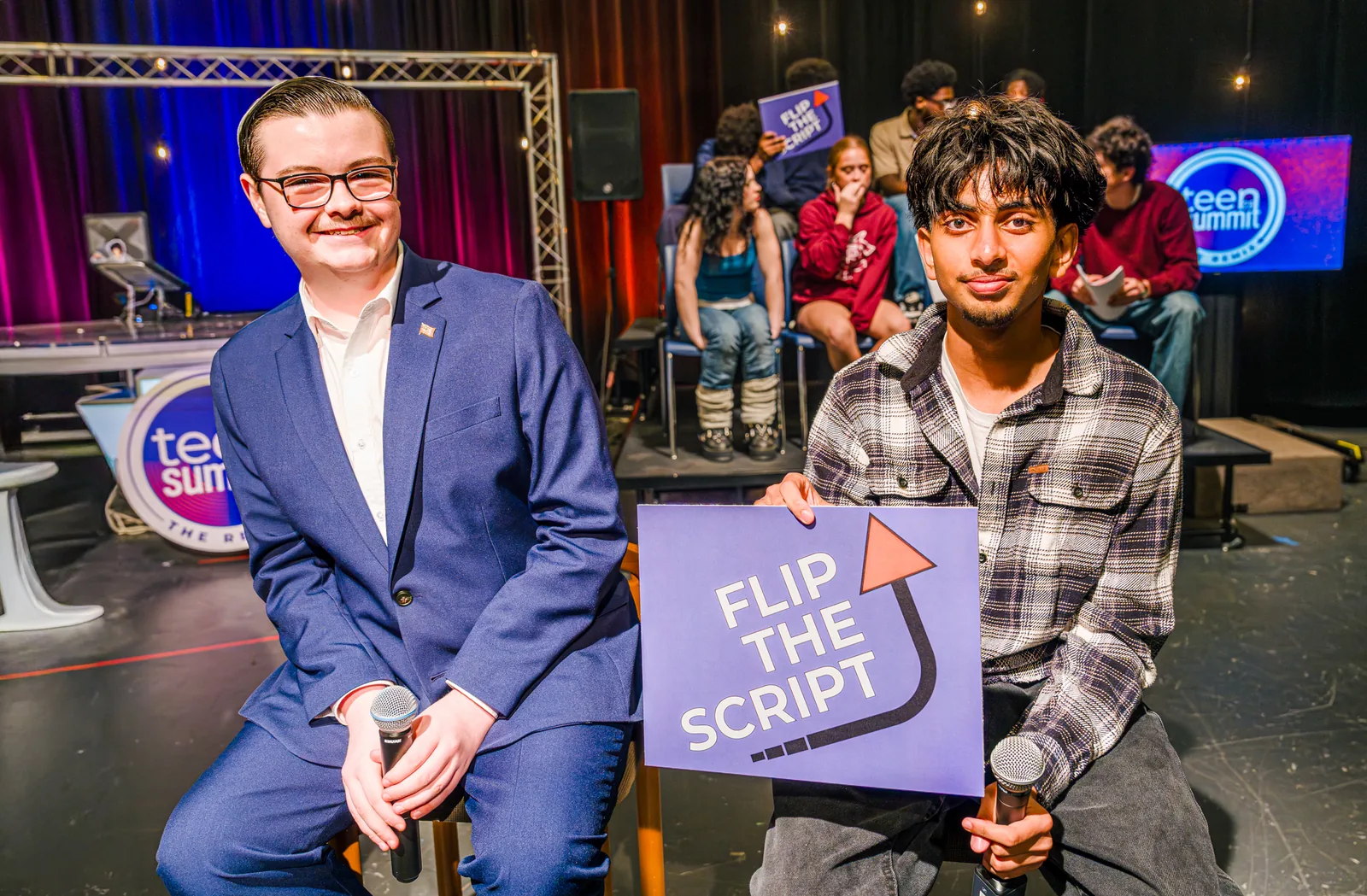
Summiteers holding the Flip the Script sign on set
Flip the Script on the Teen Summit set.

More than taking a side.

Flip the Script is a practice in perspective taking. Summiteers work with different positions on a civic question, examine the evidence behind those positions, and try to understand how someone else arrived at an answer.

Being able to explain a position does not require agreeing with it. The exercise asks Summiteers to distinguish a source, a claim, an interpretation, and a personal response.

On set

The question changes hands.

Research dossiers give the conversation a shared starting point. During dialogue, Summiteers use evidence to explore opposing positions and relate the issue to lived experience.

Musicology adds another way to interpret an argument: listen to what an artist samples, changes, or carries forward. Hosted reflection gives Summiteers space to name what changed in their own thinking.

What it trains

Read. Listen. Reconsider.

  • Source checking and media literacy
  • Explaining a position with evidence
  • Listening without reducing someone to a label
  • Reflecting on a first reaction before responding

Evidence, music and conversation.

The City of Champaign's account of the program describes Flip the Script as learning to argue both sides of important issues, guided by expert data, live DJing and podcast discussion.

The method connects preparation with performance. A research dossier supplies material to examine; dialogue tests how an argument is explained; music and reflection add cultural and personal context. The goal is not simply to win a debate.

A way to read the next civic question.

Use these prompts alongside a published dossier or program discussion. They translate the program's perspective-taking approach into questions a reader can work through.

  • Identify the claim. What is being asserted, and what evidence would support it?
  • Check the source. Who created it, when, and for which audience?
  • Explain another position fairly before responding to it.
  • Separate disagreement with an argument from judgment of the person making it.
  • Reflect on what changed, what did not, and what information is still missing.

Why culture belongs in civic learning.

Illinois Public Media's announcement describes hip-hop as a historical and cultural aesthetic informing the program's pedagogy, while leaving room for the other musical influences shaping young people's lives.

Music is not only a break between discussions. It can be read for its context, storytelling and point of view, alongside the research and lived experience in the conversation.

Explore the preparation and research

Read the approved curriculum narrative and research statement to understand how the practice fits into the show. Additional reading lists will be shared when cleared for public access.