
01 / A pilot, and what comes next
Civic life, practiced in public.
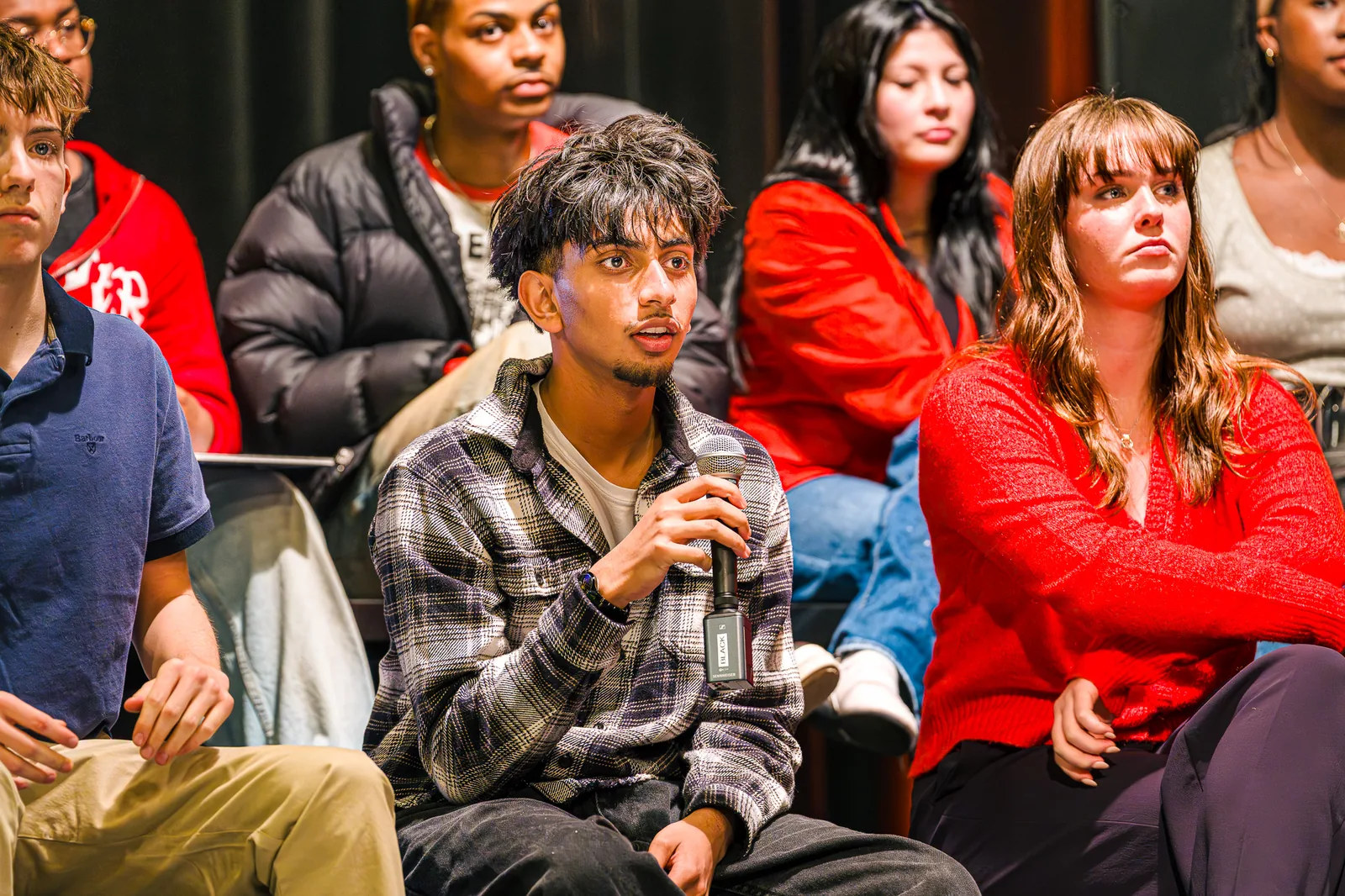
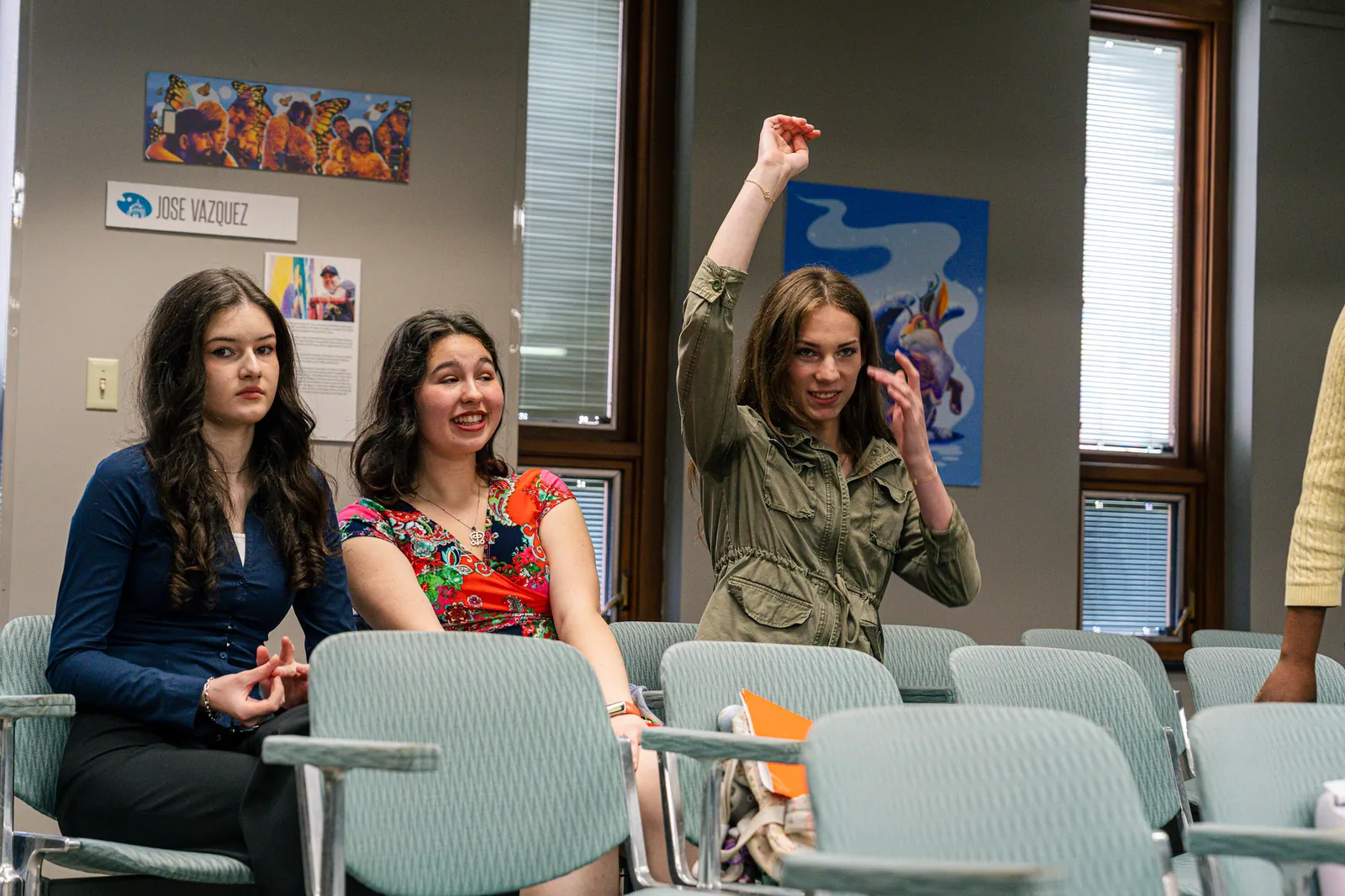
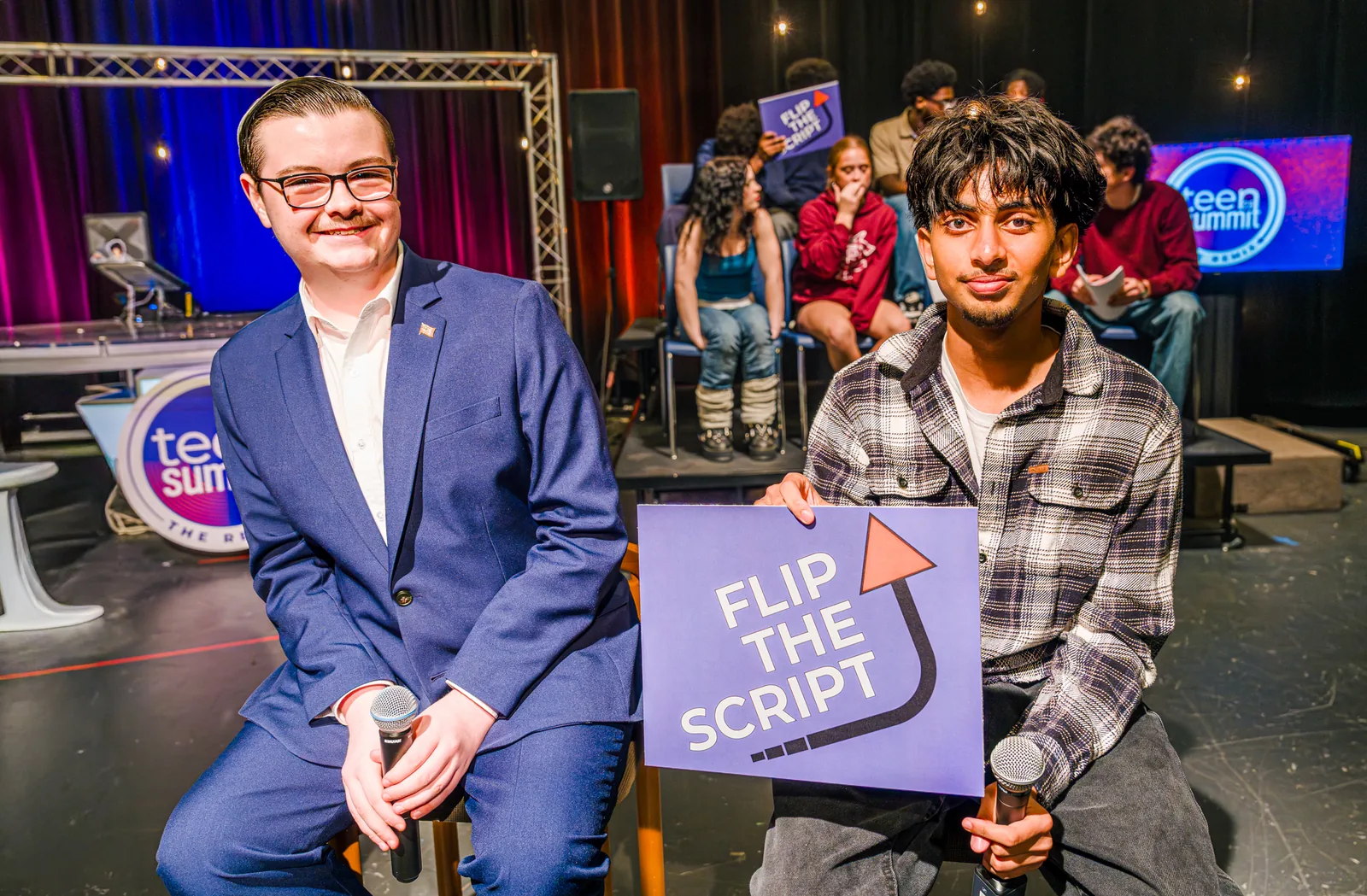
Teen Summit 2.0: The Remix is a pilot. It tested whether a research-based civic curriculum could be taught to teenagers inside a working television production and still hold up as television. The pilot season was built, filmed and wrapped in 2026 with 22 Summiteers at the University of Illinois Urbana-Champaign. The project is now seeking funding for Season One.
The project is housed in the Communiversity Public Media Project (CPMP) in the College of Education, under the University’s Publicly Engaged Research Option (PERO) pathway. Its premise is simple: young people learn civic life by practicing it in public, with facts, music and feeling in the same room.
The pilot generated broadcast footage, a digital archive, a curriculum and a first research paper. The broadcast pilot is still in post-production; this is not an announcement of a completed or aired episode. Season One is intended to turn that pilot into a study.
02 / The research intervention
The show’s design is the research.
Dr. Malaika McKee built Teen Summit 2.0 around a four-act architecture, the Quad-4. The acts are the intervention that the teens experience and that the proposed research will observe. According to the program’s statement, the March 2026 production agreement with Illinois Public Media named this architecture as the primary research intervention and as Dr. McKee’s proprietary scholarly and creative work.
| Act | Name | What the Summiteers do | Core heuristic |
|---|---|---|---|
| I | Facts | Dialogue, not debate, on a contested public question | Flip the Script, Back it Up! |
| II | Funk | Musicology: reading the civic argument inside a song | Musicology segment format |
| III | Feelings | Confessionals and group reflection on what the dialogue cost and gave | Double Click |
| IV | Fixes | Decisions and civic action beyond the studio | Academic Civic NIL |
The first three acts were filmed for broadcast. The fourth, Fixes, was added after a May 9, 2026 mock city council at Champaign City Hall showed that the teens needed a place to decide and act, not only to talk. Fixes lives on the digital side of the project, here at teensummit2.net.
The Quad-4 is documented as a metacognitive schema. Its proposed mapping onto attention and social-cognition systems is a working correspondence that guides curriculum design—not a claim about where civic reasoning sits in the brain, or evidence of specific neural changes. Whether that correspondence has value beyond a design heuristic remains a question for research.
03 / What the pilot produced
From the studio to a shared record.
The pilot ran from a public launch on February 3, 2026 to a Wrap Ceremony on June 22, 2026, with studio production from March 26 through early May. The program’s statement identifies these outputs:
- A paid pilot cohort. 22 Summiteers were cast through an open application process and employed as University Extra Help workers at $20 per hour, so that civic labor was paid labor. This describes the historical pilot cohort, not current recruitment.
- Broadcast footage, now in post-production. A full season of footage across Facts, Funk and Feelings is being shaped into a three-act broadcast pilot, with a direction to the website for Fixes.
- A curriculum. Summiteers learned dialogue heuristics, musicology and reflective practice through a Canvas course. The preserved course described on Backstage Prep is a post-pilot refinement, not an identical snapshot of the course used throughout filming.
- Measurement and design work. Work on the Quad-4 schema includes a topic audit of dialogue sessions and the design history that led to the fourth act.
- A first research paper. The statement reports a peer-reviewed paper presented at the 2026 American Educational Research Association (AERA) annual meeting.
- A digital archive. B-roll, teen confessionals and the CORN companion podcast—Conversations on Real Narratives—form short-form digital content at teensummit2.net.
The program’s statement describes the pilot as a CPMP public engagement project, conducted without an IRB protocol, and states that a protocol was not needed to produce a television program or describe a civic engagement model. This is the program’s account, not an independent regulatory determination or a claim of a vetted exemption. Season One is planned as human subjects research from the start, with IRB approval to be sought.
04 / How the pilot was built
The portfolio behind the pilot.
The November 2 statement describes an $845,000 portfolio assembled between 2024 and 2025. This is a portfolio of appropriations, allocations and reported philanthropic support—not a total of cash confirmed received or spent. Roughly $432,500 in in-kind partnership support is reported separately and is not cash funding.
| Source | Amount | Purpose | Qualification |
|---|---|---|---|
| State of Illinois program appropriation (FY26) | $330,000 | Teen Summit 2.0: Communiversity Public Media Project programming | Program appropriation; not represented here as funds received. |
| Illinois DCEO capital allocation (Build Illinois) | $350,000 | Renovation of space for a statewide media project | Capital appropriation remains in the administrative process; not confirmed received. |
| Founding gift, Ms. Sheila Johnson | $140,000 | Launch of the new Teen Summit | Reported founding gift; this statement does not independently establish receipt or spending. |
| University of Illinois Foundation / Advancement | $25,000 | Project support | Reported Foundation / Advancement support; not a receipt or expenditure accounting. |
The state appropriation was carried by Representative Carol Ammons. Ms. Johnson, creator of the original Teen Summit on BET, set one condition for the revival: the new show would be for all kids.
Production ran in partnership with Illinois Public Media under a March 12, 2026 memorandum of understanding between the College of Education and the College of Media. The Safe Haven, with Walt Bowman as digital producer, built the digital side, and Dr. Molly Niesen served as impact producer.
Dr. McKee led the project as the 2025–26 Chancellor’s Fellow for Public Engagement, an appointment that charged her with the strategic planning, development and implementation of Teen Summit 2.0.
05 / Season One: from pilot to study
What does the practice change?
The pilot demonstrated a production possibility: the Quad-4 could be taught, filmed and held together in a studio with real teenagers and real disagreement. That is not evidence of learning or neurological effects. Season One is intended to study what the experience does for participants.
Three questions lead the proposed research design.
- Dialogue, not debate. Do the Facts heuristics—Flip the Script, Back it Up!—change how teens handle a claim they disagree with, measured before, during and after the season?
- The Quad-4 as a schema. Does moving a civic question through Facts, Funk, Feelings and Fixes produce reasoning that a single-mode civics curriculum does not?
- Civic action after the cameras stop. Do the proposed Fixes commitments, carried through Academic Civic NIL and the Mayoral Recognition Program, persist past the season?
What Season One funding would support.
- Development of a research protocol for planned IRB review and approval, including pre- and post-season instruments and a comparison cohort.
- A full production season with a paid Summiteer cohort, using the pilot’s $20-per-hour standard.
- A dedicated post-production budget and editor, contracted at the start of the season rather than the end.
- Digital-side research outputs: the Quad-4 design-history paper, the topic audit and open curriculum materials.
- A community viewing and teach-in series under the Welcome Table for Democracy, so findings return to the public that produced them.
Spring 2027 is the target for Season One production, not a secured schedule. Funding, research approval, partners and venues are not announced here as secured. Partners, venues and the funding level will be announced as commitments are secured.
06 / Seeking a neuroscience research partnership
A hypothesis. An invitation to test it.
Dr. McKee’s hypothesis asks whether civic mindedness has observable neuroscientific dimensions. The pilot raised that question but could not answer it. No neurological outcome is established by the pilot.
The Quad-4 was built on a working correspondence between its four acts and systems involved in attention, perspective taking, conflict monitoring and decision-making. Facts asks a teen to hold a claim and its opposite at once. Funk asks them to hear an argument inside music. Feelings asks them to sit with what the dialogue cost. Fixes asks them to decide.
Those connections are a design heuristic, not a localization claim that each act activates one brain region. Brain regions and networks participate in many functions. The proposed research would ask whether the mapping is useful beyond curriculum design.
The project welcomes prospective collaborators in cognitive and social neuroscience, developmental neuroscience and the neuroscience of attention who want to work with a live civic intervention, a planned paid teen cohort and recorded dialogue. A partnership would help design behavioral and attentional measures, with neuroimaging considered only where feasible and appropriate for minors, and would be incorporated into the planned Season One IRB protocol from the start.
Conversations with researchers at the University of Illinois—including the Beckman Institute and the Neuroscience Program—and at other institutions are welcome. This is an invitation to develop research, not an announcement of secured research partners, an approved protocol or an open participant-recruitment process.
07 / Leadership & contact
Everyone belongs at the table.
Dr. Malaika McKee is Creator, Showrunner, Principal Investigator and Executive Producer of Teen Summit 2.0: The Remix, and composer of its theme song. She is Director of the Communiversity Public Media Project; Assistant Professor in Education Policy, Organization and Leadership in the College of Education at the University of Illinois Urbana-Champaign; and the 2025–26 Chancellor’s Fellow for Public Engagement.
The intellectual lineage of the project runs through Dr. Vincent Harding, Rosemarie Harding, Rachel Harding and the Welcome Table: the idea that everyone belongs at the table of humanity to fix the planet’s problems, teenagers most of all.
Funders, prospective research partners and community partners interested in Season One can reach the project at 217-244-5257 or staff@teensummit2.net, or through teensummit2.net.
Civitas.